
Author Archives: Jarryd Sinovich
SAAF 75 best Airshow in Southern Africa to date?

Pictures by Stefaan Bouwer
The flightline at Airforce Base Waterkloof in Pretoria during the early week of October 1995 saw a number of visiting military air arms from across the world, attended what was South Africa’s biggest military Airshow to date!

This was also the the 75th Birthday celebrations of the South African Air Force. A number of aircraft were painted up in special paint schemes for the celebration, including the SAAF Museums Mirage IIICZ “Black Widow”.

From the biggest Antonov A124 which brought a number of Russian Fighter jets in the back of the hold, including a Mig 29 and SU35. Both flying and on static display!


The Americans brought out all their bells and whistles including an F16, F15, KC135R Stratotanker, C130s, Lockheed C-141 Starlifter and many more!

Australia brought out a P-3 Orion and the Canadian Airforce attended with a Boeing 707.The Royal Airforce were here with the famous Red Arrows, C130, and a E-3 Sentry.

The South African Air Force put on a excellent variety of both new and old, including the Mirage F1AZ flown by Chris “Piranha” Pretorius, which he got struck by lightning during one of his solo displays during the show. It was one of the last shows the Impala MK1s being the Silver Falcons before being replaced by the then new Pilatus PC7 MkII “Astra”.


One has to ask will we ever see a show as big as this one day again?


Denel Cheetah C “375” flies again after 18 years!

October 9th 2020,after sitting on the ground for 18 years, Cheetah C “375” took to the skies again over OR Tambo international Airport in Kempton- Park this past week.

The aircraft was flown by Denel fixed wing test pilot Ivan “Viking” Pentz,who has a number of flying hours on both the Cheetah B,D,D2 and C models.He has also flown the Hawk MK120,Mirage F1,The AHRLAC and many more!


Extremely high quality restoration to flight work by Denel. After a few test flights, it’ll be boxed up and sent to Draken International in Florida as said by African Defence Review Darren Olivier.


“DRAKEN INTERNATIONAL HAS CREATED A NEW STANDARD IN AVIATION SERVICE CAPABILITIES FOR ALL BRANCHES OF THE UNITED STATES MILITARY, DEPARTMENT OF DEFENSE AND ALLIED MILITARIES GLOBALLY. WITH A FLEET OF 150 TACTICAL FIGHTER AIRCRAFT, DRAKEN OWNS AND OPERATES THE WORLD’S LARGEST COMMERCIAL FLEET OF TACTICAL EX-MILITARY AIRCRAFT. “


“DRAKEN SUPPORTS MILITARY TRAINING OBJECTIVES AROUND THE GLOBE, PROVIDING TREMENDOUS COST SAVINGS OVER THE USE OF TRADITIONAL MILITARY FIGHTER ASSETS. AS AN ORGANIZATION, WE ARE UNIQUELY POSITIONED TO ANSWER THE GROWING DEMAND FOR CONTRACT AIR SUPPORT.“

The Atlas Cheetah was a South African fighter aircraft designed and produced by the aviation company Atlas Aircraft Corporation now known as Denel Aeronautics. It was developed at the behest of, and principally operated by, the South African Air Force until the aircraft were retired from SAAF service to be replaced by the SAAB Gripen in 2008.
Pictures by Casper van Zyl
Aero Club Celebrates a Centenary of Recreational Flight

By Rob Jonkers
There is a sense of achievement on reaching a Century, on all manner of occasions it calls for a celebration, subject for congratulations on the significance and justifiable pride, the past century of the existence of the Aero Club of South Africa has been integral in seeing the growth in Recreational Aviation, the collective of the various disciplines
that make up flying for fun, that have allowed the freedom of development in the achievement of products, ideas, adventures, competitions that are existential of this magical world that is recreational flight.

This journey has been long, sometimes tedious and difficult but the persistence and passion of our members across the century has made it possible for the Aero Club to be the success it is today. One of the many great benefits and joys of living since the 20th Century is that we have had the immeasurable privilege to be able to fly, as since the dawn of mankind we have aspired to the ease and freedom of flight that only birds could enjoy, and from those early 20th Century years mankind learned to fly!

On the 10 th October 2020, after many months after postponement since C-19 made us all go into hiding, the Aero Club’s official Centenary Balloon Launch took place at Bill Harrop’s Balloon Safaris in the Magalies Valley. The weather outlook also looked great, and the launch event was a go sent out by the organisers just after 5 am. The wind started picking up somewhat, and first off the ground were the three commercial balloons that occurred at 6am, thereafter the Aero Club Balloon which was rebuilt in Aero Club Centenary colours (carrying the registration ZS- HOI as the ex Capital Radio balloon) was unfurled and prepared for a tethered inflation and launch.

Chairman of BAFSA Richard Bovell who was also this Centenary event organiser was the first pilot supported by student pilot Sema Mathebula, got the balloon off the ground in somewhat gusty conditions, the wind at that stage would not have been favourable to actually fly. Hanke Fourie took over from Richard for a second tethered stint, giving a good photographic opportunity for the guests in attendance.

After the balloon landed and was furled up again, the guests were treated to a scrumptious breakfast, as only one can experience as an early morning African sunrise breakfast in the bush. As MC for the event Richard Bovell gave a short speech on a brief history of sport ballooning in South Africa, thanked the guests for their attendance, and handed over the very first Aero Club Centenary Yearbook which is hot off the presses to the Doyen of Ballooning in South Africa Terry Adams, who since his arrival in SA in 1976 established the mainstay of balloon manufacturing
and pilot training in SA.

Thereafter Rob Jonkers as the Chair of the Aero Club thanked BAFSA and their team of hosting this one of a kind event, and the only event marking the Aero Club’s Centenary that will take place in 2020. A ceremonial Centenary cake cutting was then carried out by the Aero Club’s Executive Committee, Rob Jonkers (Chairman), Marthinus Potgieter (Vice-Chairman), John Gaillard (Hon Treasurer) and Hanke Fourie (Exco Member).


Although the year 2020 will go down in history as a great disrupter and has essentially rained on our Centenary parade, we will be looking at recovering much of the planned events in 2021 as time and resources will allow to bring justice to our 100 year heritage, especially poignant is to hold a 100 aircraft of all types flypast ( 101 also looks like a good number…) and an all Recreational Aviation Airweek as was initially planned for this year at Middelburg.


The Centenary coffee table book, which is now available for sale (details on the Aero Club website), is a compendium of each of our flying disciplines, historic and contemporary with numerous personalities with some
remarkable stories in recreational flying as a celebration for this signature Centenary Year.
Bell aircraft used to safeguard food and agriculture amid historic locust infestation

In the last 12 months, food security has been under serious threat from devastating swarms of locusts, destroying crops from East Africa to the Arabian Gulf. With experts warning of a “rolling emergency” 1 that could endanger harvests across the regions for the rest of the year, governments and international organizations face a herculean challenge in controlling the infestations. Aircraft from Bell, the U.S.-based helicopter manufacturer, have been playing a key role in the joint efforts to fight this ancient plague.
According to the UN Food and Agriculture Organization (FAO), desert locusts – whose destructive infestations cause major crop damage – are a species of grasshopper that live largely solitary lives until a combination of conditions promotes breeding and leads them to form massive swarms.

The region’s current crisis began in October 2019 as swarms formed along the Red Sea coastal plains in Yemen Saudi Arabia, Eritrea and Sudan, spreading eastwards across the Arabian peninsula and further south in Africa in the following months.
By January, Kenya, one of the countries hardest hit by the crisis, was already experiencing its worst outbreak of desert locusts in 70 years. To target this problem, authorities contracted South African helicopter operator BAC Helicopters, who had recently purchased three Bell 206L-4 helicopters, to carry out the Emergency Desert Locust Survey and Control operation in an effected part of Kenya.

The helicopters were tasked with surveying vast areas throughout the Marsabit and Turkana counties in Northern Kenya, locating and mapping the locust swarms which were threatening food security through the region. The 206L-4’s were each equipped with specialized Agricultural
Survey Equipment, an FDC Barrier Filter and Satellite Tracking System. Essential data gathered by the survey helicopters was then transferred to both fixed wing and helicopter spraying aircraft, allowing them to accurately target specific areas where the locust swarms were present.
Sameer Rehman, Managing Director of Africa and the Middle East, Bell, commented: “With a number of countries in eastern Africa and some parts of the Middle East at ongoing risk, the FAO has estimated that a locust control plan would cost $76 million to secure agriculture in the
affected region. Bell understands the need to protect the food source of these regions and we’re pleased our products can be essential tools in the collective mission to eradicate the problem.
“When it comes to food security, the stakes are very high so the reliability and capability of every tool used in the fight against locust swarms is paramount. The Bell 206, and newer light aircraft like the Bell 505 have shown time and again that they can be trusted to operate in high
temperatures and with heavy payloads, providing a capable defense wherever the swarms may be present.”
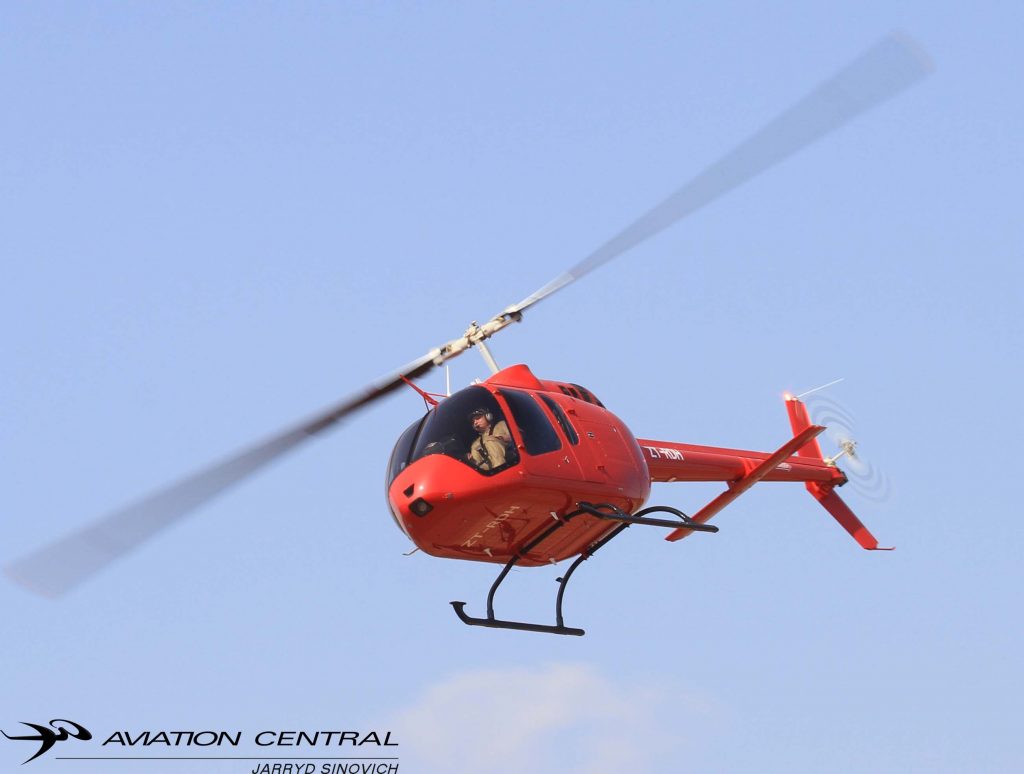
In most years, desert locust swarms tend to die out during dry season. However, with unusually high rainfall in 2020 in certain regions, the exponential growth in the populations has not abated,
creating the specter of further swarms over the coming months.
The FAO states that countries most affected by the locust situation are Ethiopia, Kenya, Somalia in Africa as well as Yemen, Saudi Arabia and parts of the UAE and Oman in the Middle East.
Retirement Of SAAF Lieutenant General Fabian Msimang

On Wednesday 30 September,members of the South African Air force and members of the media got to witness a series of beautiful flypasts from a number of aircraft of squadrons based across South Africa.A fitting tribute and thank you to the former Chief of the South African Air force!


Lieutenant General Fabian Zimpande (Zakes) Msimang integrated into the South African National Defence Force in 1994 after the first Democratic Elections as a qualified helicopter pilot.He received his flying training at Frunze 1 Central Officers Training Center – Kirghistan, in the Union of Soviet Socialist Republics between 1986 to 1991.


He graduated from the institution with a diploma in Command and Tactics of Military Aviation.During Msimang’s Career he has flown the Mi8, Mi25 ,Alouette III and Oryx Helicopters.He also completed a factory conversion onto the Agusta A109E Helicopter at Agusta/Westland now known at Leonardo in Italy.


He was a member of the Umkhonto We Sizwe (MK),the military wing of the African National Congress.He engaged in combat in Angola in 1986.In 1994,he completed the Air force Junior Staff Course in Zimbabwe before returning to the South African National Defence Force.Post 1994,he served as an operational pilot in both maritime and inland operations.

In 2000,Msimang was appointed the assistant project officer on the acquisition programme of the Agusta A109LUH in Italy.He went onto successfully complete the Senior Staff Course at the Italian Air force War School.On his return in 2003 from Italy,he was appointed the Officer Commanding of 87 Helicopter Flying School at Air force Base Bloemspruit. The Following year he successfully completed the Joint Senior Command and Staff Programme at the South African National War College.


In 2005,he was appointed officer commander of Air force Base Bloemspruit and promoted to the rank of Colonel.In 2006,he completed the Executive National Security Programme at the South African National Defence College.In 2007,Msimang,after a two and half year tour as OC at Air force Base Bloemspruit,he was appointed Director Helicopter Systems and Promoted to the rank of Brigadier General at Air Command.


In November 2010,he was appointed Chief Director Air Policy and Plans and then promoted to the rank of Major General,responsible for Air force Strategy,policies,capabilities and resource allocation.On 28 September 2012 he was accepted command as the Chief of the South African Air force from Lieutenant-General Carlo Gagiano.


Bell APT 70 Successfully Completes NASA’s Systems Integration and

Fort Worth, Texas (1 October, 2020) – Bell Textron Inc., a Textron Inc. (NYSE: TXT) company, announced today the successful flight of the Bell Autonomous Pod Transport (APT) 70 as part of a joint
flight demonstration with NASA. Bell was selected to participate in NASA’s Systems Integration and Operationalization (SIO) activity in 2018, which includes multiple flight demonstrations focusing on
different types of Unmanned Aircraft Systems (UAS) and their flight environments.
The objective of Bell’s SIO demonstration was to execute a Beyond Visual Line-of-Sight (BVLOS) mission in an urban environment transitioning into and out of Class B airspace representing future commercial
flights. Mission results will be used to evaluate and demonstrate Detect and Avoid (DAA) and Command and Control (C2) technologies for use in future certified operations in controlled and uncontrolled
airspace. Data collected during the demonstration will be used to support future standards development and Federal Aviation Administration (FAA) certification guidelines.

“This successful demonstration highlights the great potential for the APT 70 to complete complex
missions for businesses and healthcare providers,” said Michael Thacker, executive vice president,
Innovation and Commercial Business. “With teammates like NASA, we can carve a path forward for future commercial operations to solve the cargo and goods transportation challenges our world currently faces.”
Launching from Bell’s Floyd Carlson field in Fort Worth, TX, the APT 70 flew a preprogrammed 10-mile circuit path along the Trinity River. Once armed from the ground control station, the APT 70 initiated a
vertical takeoff.

The vehicle then rotated to fly on its wings where it became nearly silent to the ground below. The vehicle executed its mission profile at an altitude of 500 feet above ground level. The route
included a road crossing and transition in and out of Class B airspace. Communication between the ground station and the aircraft was maintained through a redundant datalink. A prototype airborne detect
and avoid system, along with visual observers, provided the remote pilot with awareness of air traffic in
the vicinity and recommended flight maneuvers.

NASA is excited to partner with Bell to help accelerate routine UAS operations into the national airspace
with this successful flight demo,” said Mauricio Rivas, UAS integration in the NAS project manager at NASA’s Armstrong Flight Research Center. “Our efforts with Bell and our other SIO industry partners will
help commercial UAS move closer towards certification to make missions like this transport flight a
common event.”
Bell’s technology partners for the demonstration include Xwing and the University of Massachusetts
Amherst’s Center for Collaborative Adaptive Sensing of the Atmosphere (CASA). Integrated onto the APT
70 is Xwing’s airborne, multi-sensing detect and avoid system. Xwing’s system comprises of radars, ADS- B, visual system and onboard processing to provide aircraft tracks and pilot alerts transmitted to the
ground station. The APT 70 also includes CASA’s intuitive, integrated display to provide pilots with local weather risk awareness and route-based weather alerts issued by their City Warn Hazard Notification
System deployed in the DFW metroplex.

It is envisioned that in the future, an operational APT 70 could provide efficient, rapid and dependable transport for payloads up to 70lbs. The APT 70 is estimated to move three times as fast as ground transportation. The vehicle is capable of autonomous flight, automatically flying a programmed flight route and handling an array of contingency functions. Potential uses for the APT 70 include medical deliveries,
third-party logistics, offshore delivery, humanitarian relief and many more.
South African Airways Technical reaches an agreement with its customers and reinstates Aircraft Maintenance Services

Johannesburg, 04 October 2020. South African Airways Technical (SAAT) has reached an agreement with its customers and has begun to reinstate aircraft maintenance services to some of its customers. This development follows a decision taken by SAAT to suspend maintenance services to four of its airline customers in September 2020 due to outstanding payments on services already rendered.
“We are pleased to have reached an agreement with at least two of our customers and will continue to have discussions with two others as we seek to find a resolution and settlement on these matters,” said SAAT CEO, Adam Voss.
SAAT is one of the leading Maintenance, Repair and Overhaul (MRO) entities in Africa and offers an array of services (that include base and line maintenance) to its customers to ensure that they operate in a safe and legally compliant manner. In addition, preservation maintenance is offered for the protection of the aircraft that is not operating.
“The decision we took to suspend services to our customers was not taken lightly. We had to protect our commercial interests which extend to the wellbeing of our employees who were adversely impacted by the cashflow challenges we experienced, resulting in payment of 25% of their salaries for the month of September,” explained Voss.
SAAT apologized to all its employees for the inconvenience and is in discussions with its labour unions to arrange for the payment of balance of salaries for the month of September.
South African Airways (SAA) is one of the airlines that was impacted by the suspension of the aircraft maintenance service. The airline has made a payment to SAAT and the suspension of services was lifted on Wednesday. SAA charter flights planned to operate this week were consequently not impacted by last week’s suspension.
Another customer, Mango Airlines, has reached an agreement with SAAT making it possible to lift the suspension on Mango Airlines to commence work on their fleet as of Friday. The aircraft affected returned to service on Saturday, 3 October, to transport passengers.
“We all appreciate that the aviation landscape has changed drastically due to the impact of Covid-19 outbreak globally. We know that many of our customers were not able to trade and generate much needed revenue to pay for services rendered. As part of recovery strategy and a way forward, we agreed with these customers that SAAT will receive upfront payment for services that must be rendered,” Voss concluded.

Discussions are ongoing with all affected customers to find solutions on how to address the legacy issues that resulted in the suspension of the maintenance services.
As an MRO, SAAT is satisfied with progress made and is committed to working with all its customers and partners as the industry seeks to rebuild itself and to adapt to the new norms brought about by the coronavirus.
Chief of The SAAF Lieutenant General Fabian Msimang Retreat Parade

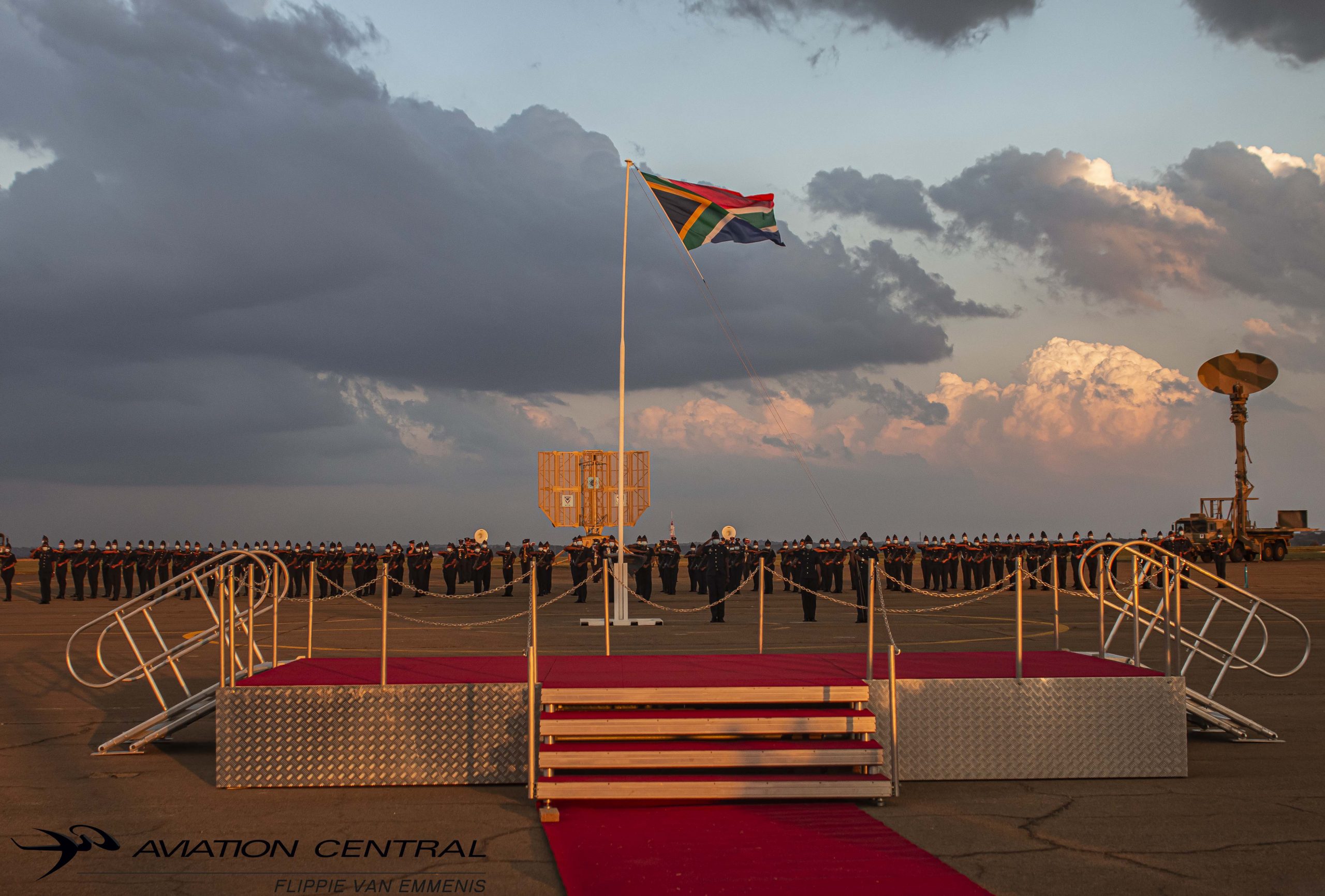
A rather sad day to be at Air force Base Swartkop on the afternoon of the last day of September 2020,cuddled around a number of cumulonimbus clouds kept their distance as a final retreat parade could take place with a magnificent background as the Chief of the South African Air Force retired.


Lieutenant General Fabian “BlackHawk” Zimpande (Zakes) Msimang,a former operational helicopter pilots on various types of SAAF Helicopters he flew during his time,including MI8,MI25,Alouette III and Oryx Helicopters just to name a few.
On 28 September 2012,Msimang was appointed the new Chief of the South African Airforce as Lieutenant-General Carlo Gagiano retired from the SAAF.

As we all know,Covid-19 has all hit us all hard,this cancelling a number of events such as airshows in the aviation industry and most important celebrating the SAAFs centenary,with the cancellation of Africa Aerospace and Defence (AAD2020),we could not have a 100 year celebration airshow taking into consideration of being the world’s second oldest air force after the Royal Airforce (RAF).And yes the Chief and the Deputy Chief Major General Innocent Buthelezi mentioned we are the second oldest air force in the world!


By 5pm a number of SAAF aircraft including helicopters and fixed wing assets took to the skies around the Pretoria area.Before the outgoing Chief opened the flypasts flying the Alouette III part of the South African Air force Museum.

The next elements of the flypast columns included the De Havilland Vampire T55,flown by Rama “Dynamite”Iyer and Vladimir “Spoetnik” Schultz.The Museums Aerospatiale Puma SA330 and Alouette II closely followed behind.


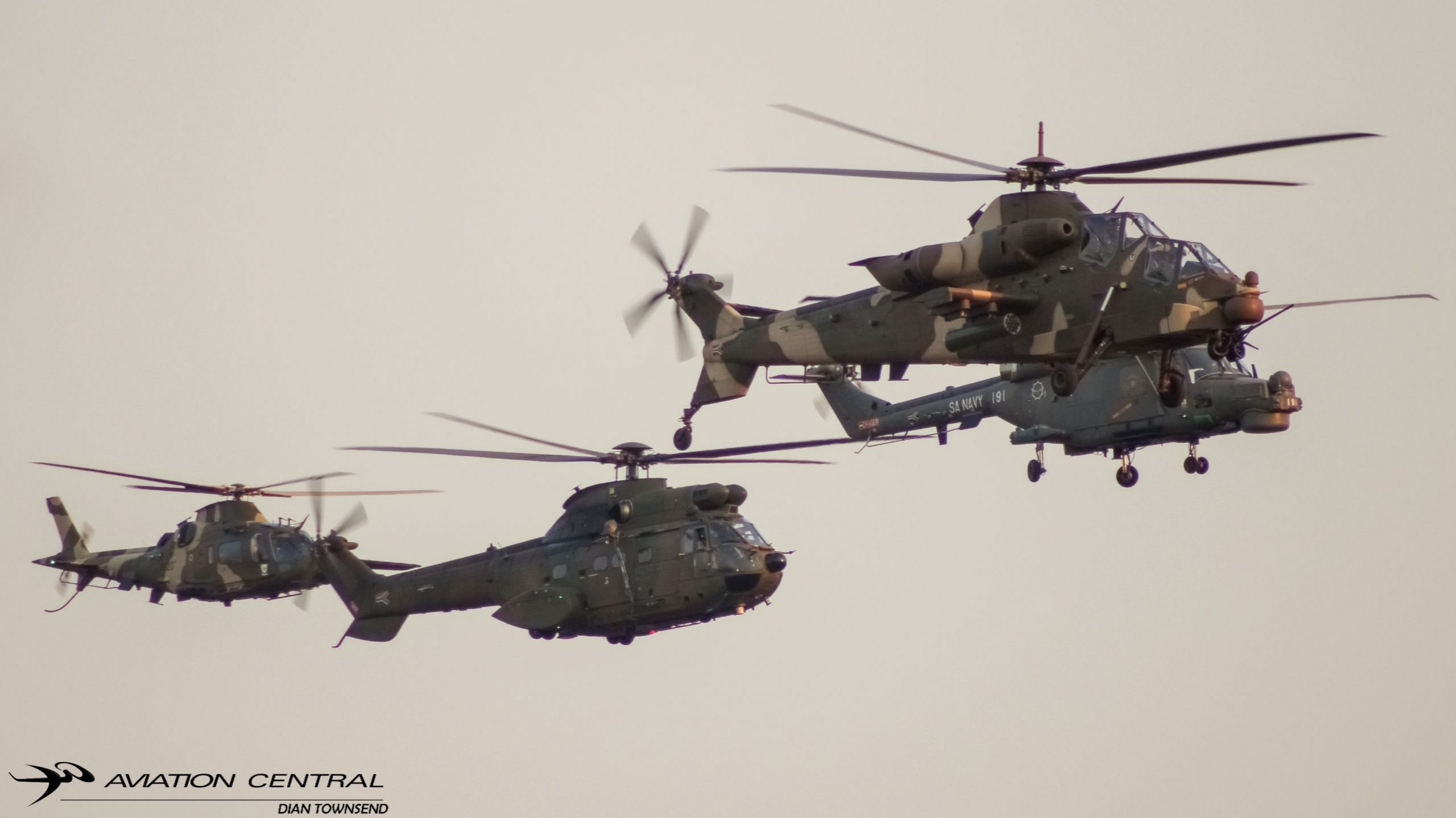
The big chopper formation was soon over Snake Valley led by a 16 Squadron Rooivalk Attack Helicopter,flanked by various helicopters from squadrons across South Africa,including two Lynx Mk 64 Helicopters all the way from AFB Ysterplaat in Cape Town,A number of Agusta A109LUHs and Oryx Helicopters also formed part of the formation.
The former school master of the sky the Harvard formation including Two Museum Harvards and two Harvard Club aircraft were next over the podium.


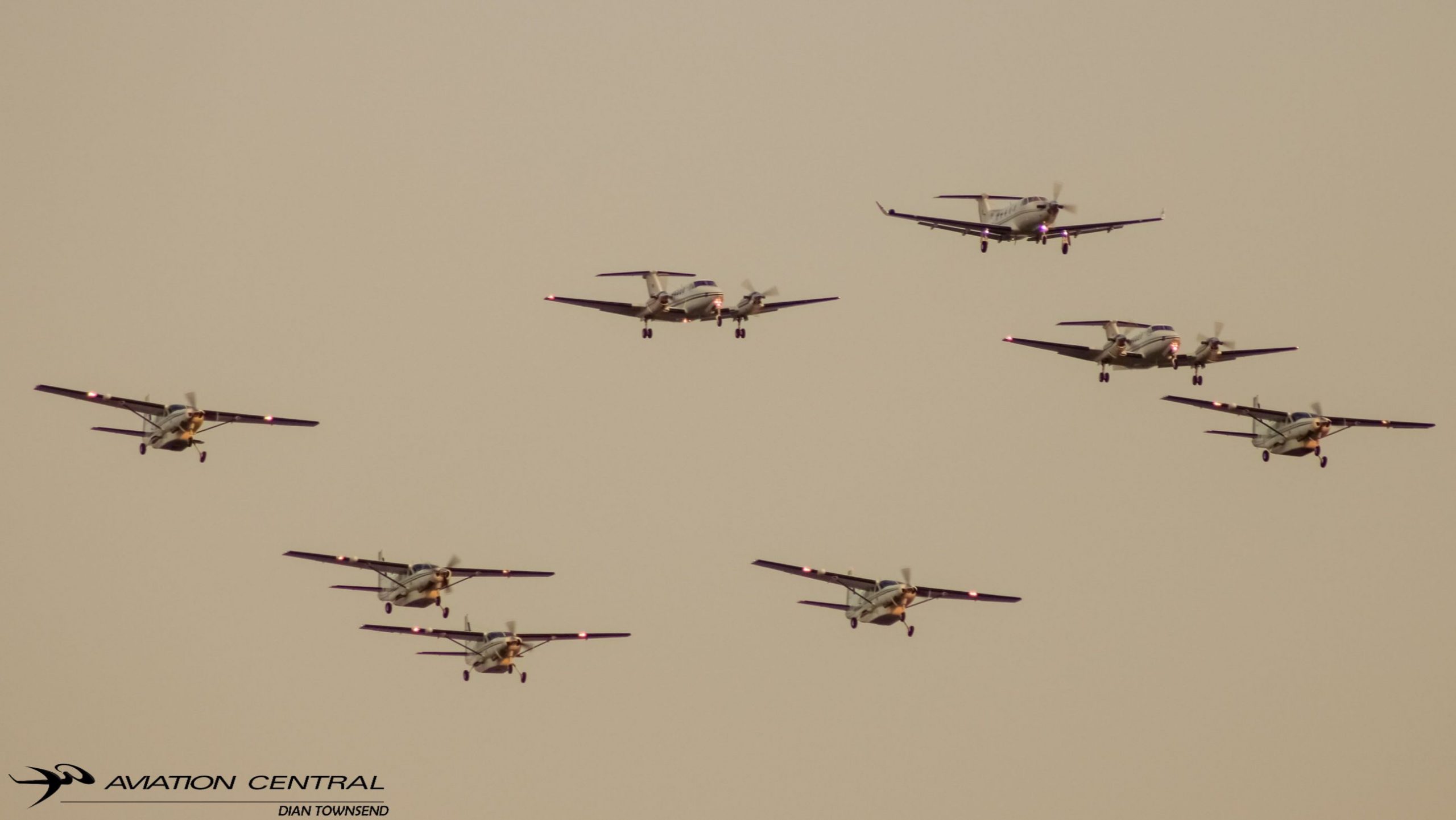
The Lycoming formation were next with a Cessna C185,a Kudu and a Bosbok making up for the taildragger aircraft in the museum fleet.41 Squadron put on a tight formation with a leading Pilatus PC12,Two KingAirs and five Cessna 208A Caravans.


Pelican Formation was next with a 35 Squadron C47TP Turbo Dakota,while a 44 Squadron Casa 212 kept tightly behind the Daks 6 o’clock position.Open the gates its 28 Squadron with Two C130BZ Hercules Transport aircraft in formation with four Central Flying School Pilatus PC-7 MKII ab initio trainers.


The last flypast was the combat formation consisting of two 2 Squadron JAS39 Gripens and four Hawks from 85 Combat Flying School.The formation was led by Major Geoffrey “Spartan” Cooper.
As the parade continued with a change of command tradition,a flag setting.


The South African Air Force band entertained the VIP Guests and members of the SAAF and Media. The surprise flypast of a Gripen from, behind the seated guests pitched up into the dark sky while releasing flares.Surely presented the chief with a final loud and spectacular goodbye.

Attending the after function,where we were kindly invited by the outgoing chief,it came time to give one final speech with tears in his eyes “he mentioned to be in an Air Force that Inspires Confidence we need to be confident in ourselves.Since I started here,I have always believed that you,each of you,are more capable.I believed and still do that you have the capacity to make this organisation into something bigger than what it was.”

We were treated to a delicious dinner and cold beverages before leaving the base,well done to all involved in making the final event for the chief a success.
We would like to wish the former chief of the South African Air force all the best for his future and a restful retirement,we’d like to take the time to thank you for making the time for us and giving us the opportunities that some didn’t have.
We thank you sir.
Video Below
Click on photo below to enlarge









Heritage Day Celebrations at AFB Ysterplaat

By Rayno Snyman
There was a buzz in the air, excitement of the unknown. We had no idea what was in store for us and what a Heritage Day it was on Thursday 24 September 2020.

We were then greeted by officer commanding Airforce Base Ysterplaat Colonel C. Moatshe. Later in the day the out going chief of the Airforce Lieutenant General Fabian Msimang, who earlier had a flight in a Pilatus PC7MkII not far up the road at AFB Langebaanweg, home of the Silver Falcons Aerobatic Team.


Airforce base Ysterplaat, which hasn’t seen an Airshow since 2011.Members of the South African Air Force, Media and friends of the South African Air Force Museum Cape Town Branch got to see some of the pristine Museum aircraft on static display as well as flying units based at Ysterplaat, such as 22 Squadron a helicopter unit and 35 Sqaudron a Maritime Patrol aircraft unit.


It was a privilege to witness the amazing aircraft that have crossed paths in our Airforce as 2020 the SAAF celebrated their Centenary. From fast jets to helicopters and the mighty Shackleton. What a treat it was. The Shackleton was the highlight of the day for us, those Griffon engines sent vibrations right to our cores, not to mention the fly by the C-47TP to perfectly commemorate the Shackleton’s own heritage.


Heritage Day was perfectly celebrated at AFB Ysterplaat as it was fantastic to see our servicemen and women, young and old, active and retired from all different backgrounds, heritages and cultures coming together to celebrate this special day. We had the honour to receive a narrated tour of the Shackleton by Mr Ashbury a former 35 Squadron unit member, who could not share the history of this aircraft and his experience with more passion, even if he tried.


Many familar faces were seen and much was learned to appreciate the effort and training of everyone at SAAF, not only pilots but the engineers, ground crew, specialists and all involved who all play a vital role in keeping us safe.


We cannot wait for next year and hope to see more of the Shackleton ground runs and maybe even a Airshow again.


First Airbus C295 aircraft arrives in Canada

Ottawa, 25 September 2020 – The first Airbus C295 aircraft, purchased by the Government of Canada for the Royal Canadian Air Force’s (RCAF) Fixed Wing Search and Rescue Aircraft Replacement (FWSAR) project, has arrived at 19 Wing, Canadian Forces Base Comox, in British Columbia, Canada.
The aircraft, designated CC-295 for the Canadian customer, landed at its home base on September 17th and is the first of the 16 aircraft contracted in December 2016. The contract also includes all In-Service Support elements, training and engineering services, the construction of a new training centre in Comox, British Columbia, and maintenance and support services.

“Airbus is really proud to be able to celebrate this important milestone: the arrival of the first out of 16 Fixed Wing Search and Rescue C295 at the Canadian Forces Base Comox. Thanks to the excellent collaboration with Canadian officials we have overcome the challenges caused by COVID-19 and we were able to deliver the aircraft. Despite the current pandemic, we are confident of achieving the program target of six deliveries by the end of this year.

We look forward to our continued collaboration and to the C295 Canada”, said Airbus Defence and Space Chief Executive Officer, Dirk Hoke, on a video statement displayed during an official event held today at the 19 Wing Comox Air Base.

Airbus has formally delivered three aircraft to date, the second of which is scheduled to arrive in country in the coming weeks. Deliveries will continue until 2022.